Guided Surgery

Discover a new way to guide your surgeries: no friction, no particle release, no overheating, total control of the drilling and a minimum number of components.

Know more
Contact
Home >
Solutions and Products >
Oral implantology >
Guided Surgery >

WHAT IS STOP & GUIDE®?

Stop & Guide® is a surgical system for guiding the placement of dental implants in a novel way. It is a versatile system that can be used as a “drill stop kit” in conventional (freehand) surgery, or as a “guided surgery kit” to perform piloted, semi-guided and fully guided surgery.
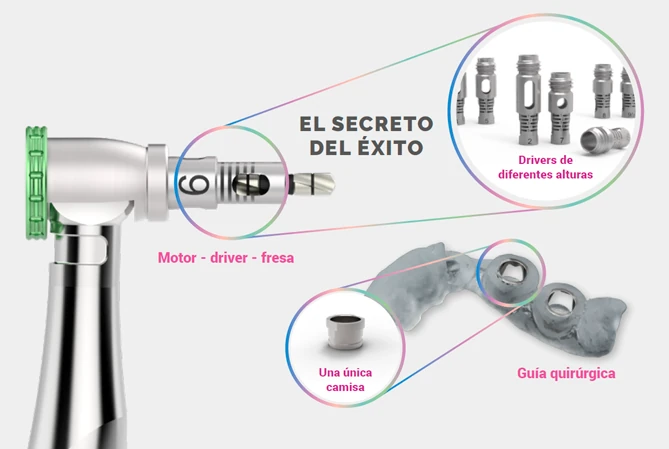
Why choose the guided surgery of BTI, STOP & GUIDE®?

  1. VERSATILE
    Adaptable to different guided surgery protocols: Piloted / Semi-guided / Fully guided.
  2. ASSURANCE
    No friction between drills and guide sleeve, no overheating and no release of particles.
  3. SIMPLIFIED
    No specific drills and a very small surgical box.
  4. ACCURATE
    Full control of drilling depth.
  5. SIMPLE
    Your conventional drilling sequence guided by a driver.
Guided surgery - dental surgery driver
arrow separator
Guided surgery - clinical case

What is needed to perform guided surgery with the STOP & GUIDE® system?

To perform any of the 3 types of static guided surgery (piloted, semi-guided or fully guided) it is necessary to have:

  • A radiographic study of the patient (CBCT) and a scan of the surface of the patient's mouth (.stl).
  • A surgical guide designed using planning software that allows for the inclusion of specific S3CG and SCG titanium master sleeves. Guided surgery - connector
  • A W&H surgery contra-angle handpiece (WI-75 E/KM), compatible with the connector to which the drivers are attached.
  • A Stop & Guide® guided surgery kit, as well as the sequence of drills required for the planned implant dimensions.
EXCLUSIVE VIDEO

BTI's guided surgery step by step

Discover how the STOP & GUIDE® system works to help you guide your surgeries like never before.

Watch video

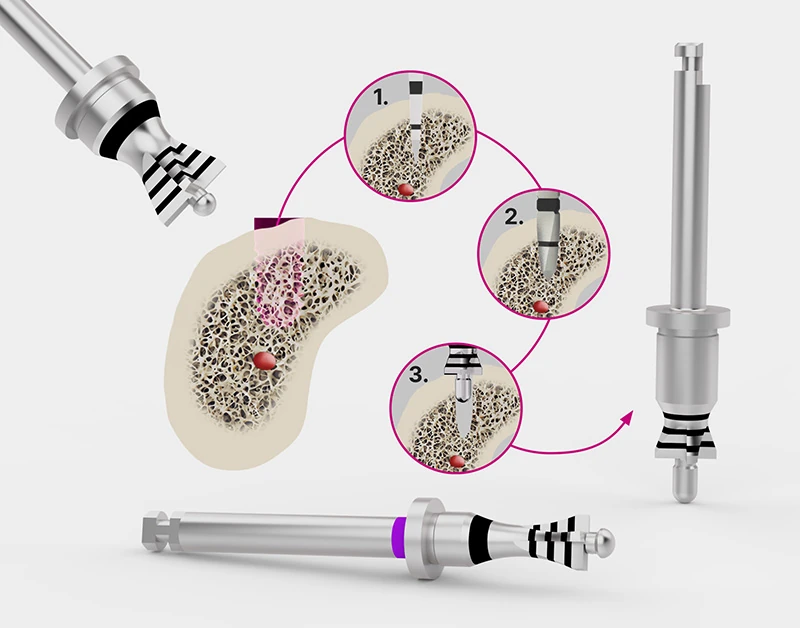
Ridge regularisation: flattening drills

These enable controlled regularisation of the ridge prior to the drilling of the implant site. They must be used at low speed and are particularly useful in:

  • Situations where there is a discrepancy between the lingual/palatal and buccal/vestibular height.
  • “Knife-edge” or narrow ridges.

The indication for these flattening drills is for non-single edentulous spans; they are not recommended in situations with limited interdental space. Their design favours the harvesting of autologous bone, and the design of their apical end facilitates precise control during use, even in conventional (non-guided) surgery protocols.
fresas aplanadoras regularizacion de crestas

Do you want to know more about BTI's innovative guided surgery system?